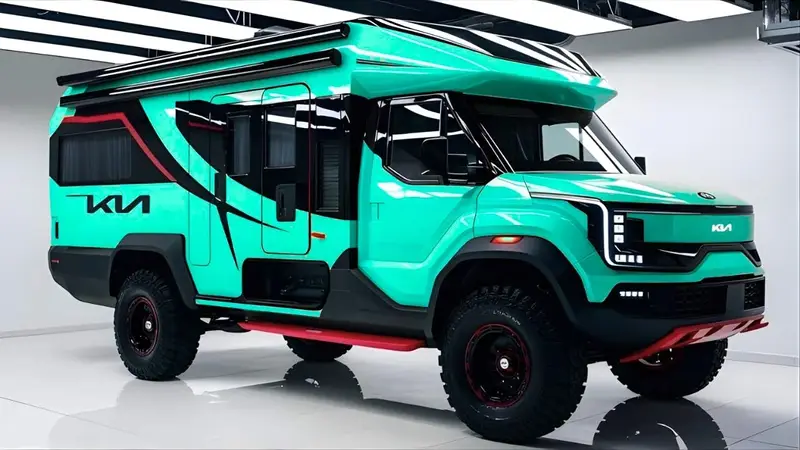
The 2026 Kia camper van has attracted attention from people looking for a smaller and more modern way to travel. Kia is expanding its electric van lineup with the PV5, a flexible vehicle that can be adapted for different uses, including camping.
But there is an important point about the headline price. Kia has confirmed the PV5 and its camper conversion plans, but a $20,000 starting price for a fully equipped production Kia camper van has not been officially confirmed. The real story is the PV5’s electric platform, flexible design and planned camper versions.
Kia’s New Camper Idea Is Built Around the PV5
The Kia PV5 is the first model in Kia’s new Platform Beyond Vehicle, or PBV, family. It is an all-electric van designed to serve different purposes rather than being limited to one body style.
Kia has developed the PV5 in several forms, including passenger, cargo and chassis cab versions. The company has also announced conversion models, including a Light Camper. Kia says its PBV strategy is designed to make the vehicle adaptable for different personal and business needs.
This is what makes the PV5 different from a traditional camper van. Instead of starting with an ordinary van and modifying everything afterward, Kia designed the vehicle to work with different conversion options.
The approach could make the PV5 useful for people who want one vehicle for normal driving during the week and camping trips on weekends.
Is the $20,000 Starting Price Official?
The $20,000 figure needs to be treated carefully.
There is currently no confirmed Kia announcement showing that a fully equipped 2026 Kia camper van will be sold for exactly $20,000. Kia has confirmed its PV5 camper direction, but the company has not confirmed that price as the retail starting price for a production camper.
This matters because the price of a camper is normally higher than the price of the basic van itself. Camping equipment, interior conversion work, battery size, taxes and local market costs can all affect the final price.
For that reason, buyers should not assume that the headline $20,000 figure represents the final price of a Kia PV5 camper.
| Detail | 2026 Kia Camper / PV5 |
|---|---|
| Main vehicle | Kia PV5 |
| Powertrain | Fully electric |
| Platform | E-GMP.S |
| Camper direction | Light Camper and other conversion plans |
| Standard battery option | 51.5 kWh |
| Long-range battery option | 71.2 kWh |
| Maximum published PV5 range | Up to 416 km WLTP on the applicable version |
| DC fast charging | About 30 minutes from 10% to 80% under suitable conditions |
| Confirmed $20,000 camper price | No |
The exact specifications and equipment can vary by market and vehicle version. Kia also notes that real-world range can change with driving style, speed, weather, load and the use of electrical equipment.
Electric Power Could Be a Major Advantage
The PV5 is powered entirely by electricity. Kia offers battery choices including a 51.5 kWh standard-range battery and a 71.2 kWh long-range battery in its published specifications.
The long-range version is listed with a maximum WLTP range of up to 416 km in one current market specification. The standard-range version is listed at up to 297 km. WLTP is a controlled test used to compare vehicle range, but actual driving distance can be lower.
Charging speed is another important part of the vehicle. Kia lists DC fast charging from 10% to 80% in less than 30 minutes under the stated conditions for the PV5 Cargo.
For a camper, charging is especially important because travelers may carry extra weight and use electrical equipment while camping. That means owners will need to plan longer journeys around available charging stations.
The vehicle can also support Vehicle-to-Load, or V2L, technology. This allows the vehicle’s battery to provide power to compatible external equipment, adding another useful feature for outdoor trips.
What Could Make the PV5 Useful as a Camper?
The biggest strength of the PV5 is its flexible design.
Kia has developed the vehicle as a modular platform. That means different versions can be built around the same basic vehicle architecture. The company’s announced PBV plans include camper conversions alongside passenger and commercial versions.
For campers, this could provide a more practical alternative to a large motorhome.
A compact van is generally easier to drive in cities and can be easier to park than a large RV. It can also be used for everyday transportation when the owner is not traveling.
Some of the most important advantages of the concept are:
- Fully electric driving instead of gasoline or diesel power.
- A modular design that can support different conversion types.
- A smaller van format that can be easier to use every day.
- Fast charging and V2L technology that can be useful during trips.
The exact camping equipment will depend on the final camper conversion and the market in which it is sold.
Battery Options and Performance
The PV5’s two main battery choices give buyers different priorities.
The 51.5 kWh version is aimed at customers who need a lower battery capacity and shorter range. The 71.2 kWh version provides the longer driving range and is likely to be more attractive to people who regularly take longer trips.
Kia’s published figures show the following:
| Specification | Standard Range | Long Range |
|---|---|---|
| Battery | 51.5 kWh | 71.2 kWh |
| Maximum stated range | 297 km WLTP | 416 km WLTP |
| Motor output | 89.4 kW | 120 kW |
| Maximum torque | 250 Nm | 250 Nm |
| Maximum speed | 135 km/h | 135 km/h |
| DC charging, 10%-80% | Under 30 minutes | Under 30 minutes |
These figures are based on Kia’s published PV5 specifications and can differ between markets and versions. Real-world range can also change because of weather, speed, road conditions, vehicle load and other factors.
The Interior Is Where the Camper Conversion Matters
A camper van is not judged only by its battery and driving range. The interior layout is just as important.
Kia’s PBV strategy is built around flexible interiors and different uses. The company describes its PBV vehicles as spaces that can support living, working and other activities rather than simply being transportation.
For the camper versions, the conversion can determine how much sleeping, storage and living space is available.
This is also why the $20,000 claim should not be taken as the price of a luxury RV with every possible feature. A basic vehicle and a fully equipped camper conversion are very different products.
The final camper price will depend on the equipment included in the conversion, the battery selected, taxes, registration costs and the market where the vehicle is sold.
How Far Can the Kia Camper Travel?
The long-range PV5 has a published WLTP range of up to 416 km in the relevant specification. That figure provides a useful benchmark, but it should not be treated as a guaranteed distance for every road trip.
A camper conversion can add weight. Camping equipment, passengers, luggage and outdoor gear can all affect energy use.
Highway speeds can also reduce electric range compared with slower city driving. Cold weather and heavy use of heating or air conditioning can have an additional effect.
For this reason, someone planning long camping trips should consider charging locations rather than relying only on the maximum advertised range.
Kia Is Planning More PBV Models
The PV5 is not intended to be Kia’s only PBV.
Kia’s announced plans call for a larger PV7 in 2027 and a PV9 in 2029. The company has positioned these vehicles as part of a wider PBV lineup designed to cover different customer needs.
This could become important for the camper market because larger vans can provide more room for sleeping areas, storage and other equipment.
For now, however, the PV5 remains the key Kia model for buyers interested in a compact electric van that can be adapted for camping.
What Buyers Should Know Before Believing the $20,000 Claim
The biggest takeaway is simple: the Kia camper project is real, but the $20,000 price should not currently be presented as an officially confirmed retail price.
Kia has confirmed the PV5, its electric platform and its plans for conversion models that include camper versions. The company is also expanding the PV5 lineup across different markets during 2026.
However, prices and equipment differ from one country to another. Kia’s published information also makes clear that vehicle specifications can vary by market.
Anyone considering the vehicle should therefore check the price and equipment for the exact country and version before making a buying decision.
2026 Kia Camper Van: What We Know So Far
The 2026 Kia camper van is shaping up to be an interesting entry into the electric camping market. The PV5 combines a compact van body with an electric powertrain and a flexible platform designed for different conversions.
Its biggest attractions are the available long-range battery, fast charging, modular design and potential for camper use. The vehicle could appeal to travelers who want something smaller than a traditional RV while still having a dedicated space for road trips.
But the $20,000 starting price remains unconfirmed. There is no verified Kia announcement establishing $20,000 as the retail starting price of a fully equipped 2026 Kia camper van.
That distinction is important. The strongest confirmed part of the story is not the $20,000 price. It is Kia’s plan to turn the PV5 into a flexible electric vehicle that can be adapted for camping and other uses.
If Kia can offer the camper conversion at a competitive price, the PV5 could become an interesting choice for people who want an electric vehicle that can double as a weekend adventure van. For now, buyers should wait for official market-specific pricing and final camper specifications before treating the $20,000 figure as fact.