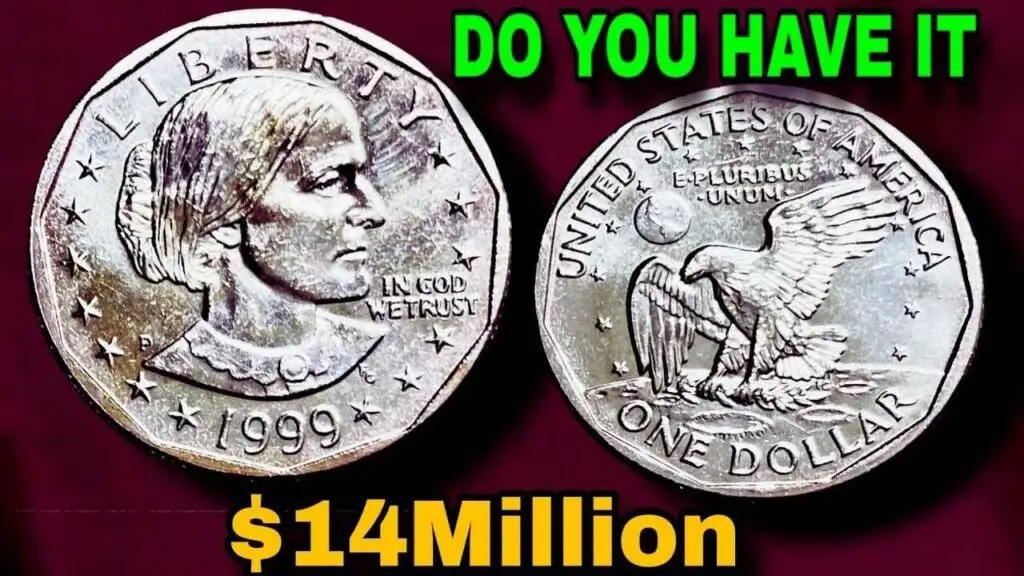
The 1999-P Susan B. Anthony dollar is a coin that can easily be overlooked. It looks like a simple $1 coin, but some examples in exceptionally high condition can be worth far more than face value.
The important thing is condition. Millions of 1999-P Susan B. Anthony dollars were made, so an ordinary circulated coin is generally not rare. However, a top-quality example can be worth hundreds of dollars according to current collector price guides.
What Is the 1999-P Susan B. Anthony Dollar?
The 1999-P Susan B. Anthony dollar was made at the Philadelphia Mint. The “P” mint mark identifies Philadelphia as the place where the coin was struck.
The coin is part of the Susan B. Anthony dollar series, which began in 1979. The 1999 issue is especially interesting because it was the final year that the U.S. Mint produced Susan B. Anthony dollars for regular circulation.
The 1999-P issue had a mintage of 29,592,000 coins. It is made from copper and nickel over a copper center, weighs 8.1 grams and measures 26.5 millimeters across.
| Feature | 1999-P Susan B. Anthony Dollar |
|---|---|
| Year | 1999 |
| Mint mark | P |
| Mint | Philadelphia |
| Face value | $1 |
| Mintage | 29,592,000 |
| Weight | 8.1 grams |
| Diameter | 26.5 mm |
| Composition | Copper-nickel clad copper |
| Designer | Frank Gasparro |
| Series | Susan B. Anthony Dollar |
Is the 1999-P Susan B. Anthony Dollar Rare?
Not in ordinary condition.
The nearly 30 million coins produced in Philadelphia mean that collectors can still find many 1999-P dollars. A circulated example usually does not carry a large premium simply because it is more than 25 years old.
This is where coin collecting can be different from what many people expect. Age alone does not make a coin valuable. Rarity, condition, demand and special features can all affect its price.
For the 1999-P dollar, condition is especially important.
A coin that has spent years moving through banks, stores and people’s pockets will usually have scratches, marks and other signs of use. A coin that was protected soon after being made may retain much more of its original appearance.
That difference can be worth a lot of money at the highest grades.
How Much Is a 1999-P Susan B. Anthony Dollar Worth?
According to the NGC price guide, as of July 2026, circulated 1999-P Susan B. Anthony dollars are generally valued around $1.05 to $1.35. The same guide lists much higher values for coins in very high Mint State grades, reaching $700 for MS68.
These are guide values, not a guarantee that every coin will sell for those amounts. Actual selling prices can change depending on grading, certification, buyer demand and the individual coin.
| Grade or condition | NGC guide value |
|---|---|
| Circulated | About $1.05-$1.35 |
| MS60 | About $1.10 |
| MS61 | About $1.10 |
| MS62 | About $1.20 |
| MS63 | About $1.35 |
| MS64 | About $2 |
| MS65 | About $3 |
| MS66 | About $5 |
| MS67 | About $12 |
| MS68 | About $700 |
The major jump happens at the very high end. This shows why finding a 1999-P dollar is not the same as finding a $700 coin. The coin generally needs to be in an exceptionally high grade to reach that level in the NGC guide.
Why Can a $1 Coin Be Worth Hundreds?
The answer is condition.
Coin grading uses a scale that helps describe how well a coin has survived. “MS” means Mint State and is used for coins that show no wear from normal circulation. Higher numbers represent coins with stronger overall condition.
A coin graded MS60 is already considered uncirculated, but it can still have noticeable marks. As the grade gets higher, the standards become much harder to meet.
An MS68 example is therefore very different from a coin that has simply been sitting in a drawer for years.
PCGS lists the 1999-P Susan B. Anthony dollar as a regular-strike issue with a mintage of 29,592,000. Its records also show that the coin has appeared in very high grades, while its auction records demonstrate that individual coins can bring very different prices depending on grade and circumstances.
This is why collectors pay close attention to the smallest marks on high-grade coins.
What Should You Check on Your 1999-P Dollar?
If you have a 1999 Susan B. Anthony dollar, begin with the mint mark.
Look for the letter “P” on the obverse, the side showing Susan B. Anthony. If it has a “P,” you have the Philadelphia version discussed in this article.
Next, examine the condition under good lighting. Do not immediately clean the coin. Cleaning can change the original surface and may hurt its appeal to collectors.
Look for these details:
- Scratches or marks across the main surfaces.
- Signs of wear on Susan B. Anthony’s portrait and other raised areas.
- Original shine and overall surface quality.
- Whether the coin appears to have been stored carefully instead of circulated.
A magnifying glass can help you spot small marks, but remember that a coin can look excellent to the naked eye and still receive a lower professional grade.
What Does MS68 Mean?
MS68 is a very high Mint State grade.
It does not simply mean that the coin looks “new.” Professional graders examine the surfaces and overall quality very closely. Tiny marks that are difficult to see without magnification can make a major difference when a coin is being considered for a top grade.
This is one reason why two coins that look almost identical to a casual observer can have very different market values.
For the 1999-P issue, NGC’s current guide shows $700 at MS68, while lower Mint State grades are valued much less.
Collectors should therefore be careful when seeing online advertisements claiming that any uncirculated 1999-P dollar is automatically worth hundreds. Being uncirculated is not enough by itself to guarantee a high value.
Could an Error Make the Coin More Valuable?
Mint errors can sometimes increase the value of a coin, but a strange-looking coin should not automatically be called a rare error.
A genuine mint error happens during the manufacturing process. It is different from damage caused after the coin leaves the Mint.
For example, scratches, dents, discoloration and damage from machines or other objects can happen after production. These problems usually do not make a normal coin rare.
If a 1999-P dollar appears to have an unusual feature, it is better to have the feature examined by someone familiar with U.S. coins before assuming it is valuable.
The regular 1999-P Susan B. Anthony dollar is already a recognized issue, and its value is strongly tied to condition rather than simply having the “P” mint mark.
Should You Have Your Coin Professionally Graded?
Professional grading may be worth considering if your 1999-P dollar appears to be in exceptional condition.
There is little reason to spend money grading an ordinary circulated coin that is worth close to $1. The cost of grading can be much higher than the coin’s value.
The situation is different if the coin looks nearly flawless and may have a chance of receiving a very high Mint State grade.
A professional grading service can authenticate the coin, assign a grade and place it in a protective holder. Certification can also make it easier for buyers and collectors to understand exactly what they are purchasing.
Before submitting a coin, however, it is sensible to compare the likely value of the coin with the total cost of grading and shipping.
What Makes the 1999-P Issue Interesting to Collectors?
The 1999-P dollar has several things going for it from a collecting standpoint.
First, it belongs to the Susan B. Anthony series, which is an important part of modern U.S. coin history. Second, 1999 was the final year of production for the series. Third, while the regular issue is not rare in general, examples at the highest grades are much more interesting to collectors.
The combination makes the coin worth checking, especially if you find one that has been stored in an original collection, coin set or other protected environment.
Still, it is important to keep expectations realistic. Most examples will not be worth hundreds of dollars.
1999-P Dollar vs. 1999-D Dollar
The U.S. Mint also produced a 1999-D Susan B. Anthony dollar at the Denver Mint.
The two regular issues are similar in appearance, but their mintages were different. NGC lists 29,592,000 examples for the 1999-P issue, while the 1999-D issue had a smaller mintage of 11,776,000.
That difference does not mean every 1999-D coin is automatically valuable. Condition still matters, and the specific coin must be evaluated on its own.
For someone checking a collection, identifying the mint mark is therefore a useful first step.
Don’t Confuse Asking Prices With Real Coin Values
One of the biggest problems with online coin searches is the difference between an asking price and an actual market price.
Someone can list a common coin online for hundreds or even thousands of dollars. That does not mean buyers are actually paying that amount.
A more useful approach is to look at established price guides and documented sales of comparable coins. Even then, prices can vary because no two coins are exactly alike.
For a 1999-P Susan B. Anthony dollar, the grade is especially important. A circulated coin near face value should not be compared with a professionally graded MS68 example.
Could Your 1999-P Dollar Be Worth Hundreds?
Yes, but only if the coin is in an unusually high condition or has another feature that gives it extra collector interest.
The average circulated 1999-P Susan B. Anthony dollar is not a hidden fortune. Current NGC guide values put circulated examples at roughly $1.05 to $1.35. However, the same guide lists an MS68 example at $700, showing how dramatically value can change at the highest grades.
So, if you have a 1999-P Susan B. Anthony dollar, don’t throw it away and don’t assume it is worth hundreds just because it is old.
Check the mint mark, inspect the surfaces carefully, avoid cleaning the coin and pay close attention to its condition. If it looks exceptionally well preserved, professional evaluation may be worthwhile.
For most people, the 1999-P dollar will remain a $1 coin. But for someone lucky enough to have an exceptionally high-grade example, that ordinary-looking dollar could be considerably more valuable to collectors.